
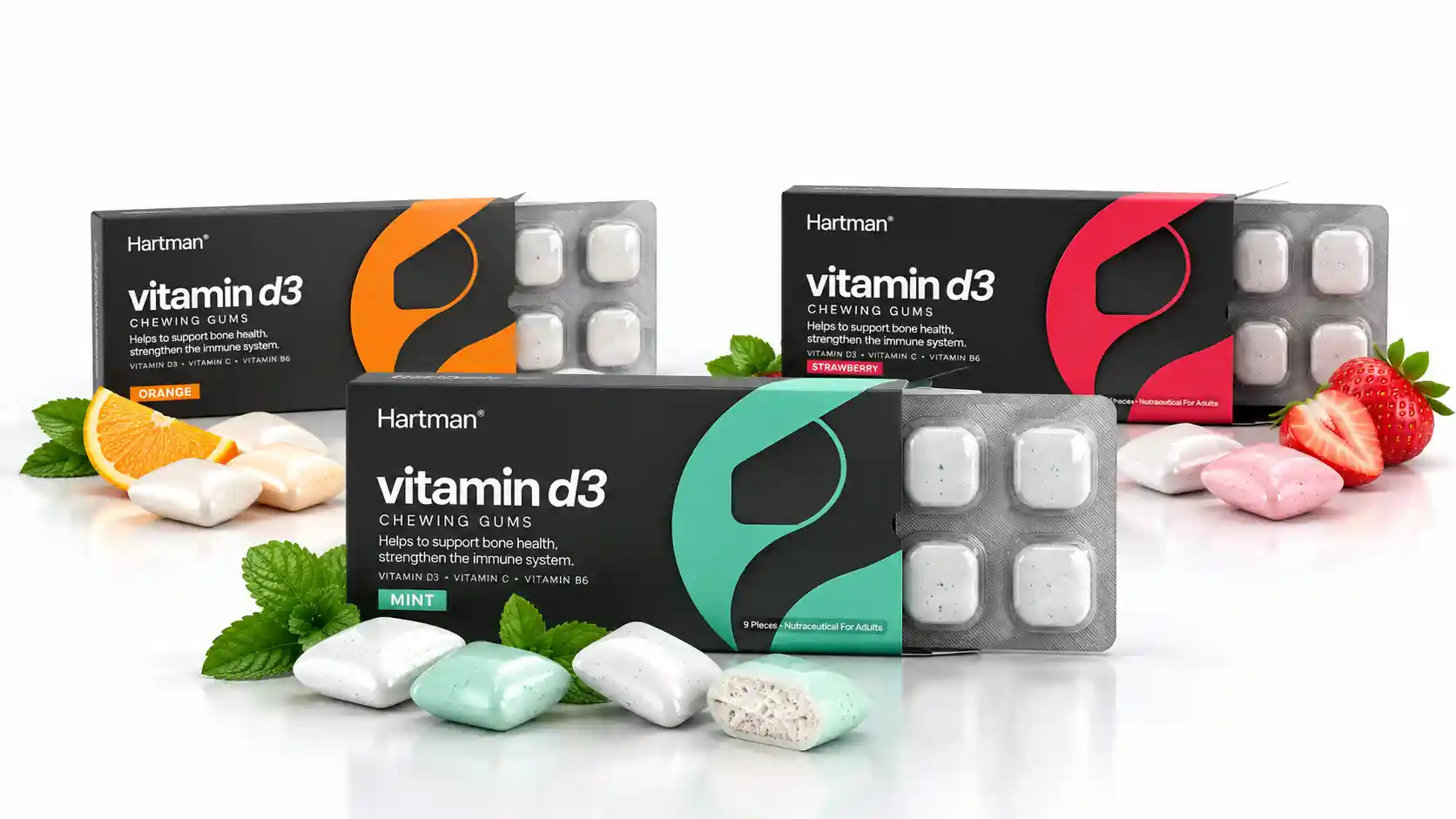
Functional chewing gum offers supplement brands an alternative to traditional capsules, tablets, powders and beverages. Instead of swallowing a capsule or preparing a drink, consumers can chew a product containing selected functional ingredients.
For brands developing products in categories such as energy, focus and general wellness, this creates opportunities for product differentiation. However, development is more complicated than adding vitamins or caffeine to conventional gum: ingredient compatibility, taste, texture, release, stability and manufacturability all matter.
What Is Functional Chewing Gum?
Functional chewing gum contains selected active ingredients intended to provide nutritional or functional benefits, alongside the flavour and chewing experience of conventional gum. Depending on formulation and local rules, ingredients may include caffeine gum, L-theanine, selected vitamins, certain minerals and botanical extracts. Inclusion alone does not prove effectiveness: stability and release during chewing require evaluation.
Why Are Brands Exploring This Format?
Functional chewing gums are being considered by brands due to the easy delivery of selected nutrients using this form. The functional chewing gum will provide supplement brands the scope to offer new products with a variety of flavors, textures, and experience.
Convenient Consumption
Gum is portable and generally requires no water.
Familiar Consumer Experience
Consumers already know how to chew gum, which can simplify the product experience.
Product Differentiation
Brands can explore an alternative to conventional tablets, capsules, powders and drinks.
Ingredient Release during Chewing
Active ingredients may move into saliva during chewing. Some may be absorbed through oral tissues while others are swallowed and absorbed through the gastrointestinal tract. The relative pathways depend on the ingredient and product. Faster action or superior bioavailability must not be assumed without product-specific evidence.
How Is Functional Chewing Gum Manufactured?
The manufacture of functional chewing gum is done through different processes starting from planning up to packaging. The processes help in ensuring that the gum conforms to the requirements of the brand.
Define the concept
Establish target consumers, ingredients, serving size, flavour, market and desired experience.
Evaluate feasibility
Assess ingredient loading, taste, stability, release and regulatory suitability.
Develop the gum formulation
Select a suitable gum base and compatible sweeteners, flavours, softeners and active ingredients.
Optimise flavour and texture
Address bitterness, astringency, mouthfeel and flavour persistence.
Evaluate prototypes
Review taste, sweetness, texture, appearance, uniformity and relevant release characteristics.
Finalise production and packaging
Approve specifications, materials, testing requirements, packaging and production scheduling.
The Challenge of Active Ingredient Loading
There is no universal maximum amount of active ingredient per piece. Capacity depends on the ingredient, gum composition, piece weight, process and desired texture. Combining caffeine, L-theanine and vitamins may look simple on paper but may alter texture, bitterness, distribution, processing or stability. A capsule formulation cannot automatically be transferred into gum.
Why serving size matters
Using more than one piece per serving may increase formulation flexibility, but changes the user experience, packaging and positioning. Decide the serving configuration early.
Why Taste Masking Matters
Functional ingredients may taste bitter or astringent. Caffeine is a familiar example. Sweeteners, flavours and ingredient-processing approaches may help, but changes can also influence ingredient release and product performance. Early prototype tasting is essential.
Illustrative development scenario: a multi-ingredient gum appears feasible until chewing reveals a persistent bitter aftertaste. The development team may need to revise flavour systems, ingredient specifications or the formulation before scaling up. This example is illustrative and contains no client-specific information.
Does the Gum Release All Its Active Ingredients?
Not necessarily. Ingredients must leave the gum matrix and enter saliva before becoming available for absorption. Release depends on solubility, gum-base composition, distribution, chewing duration and chewing intensity. Some ingredients may remain in the gum after use; the amount added is not automatically the amount released.
Published caffeine gum research illustrates that release and absorption can vary with chewing time and product formulation. Findings from one gum should not be treated as universal release percentages for other products.
Caffeine Chewing Gum: A Product Development Example
A caffeine chewing gum manufacturer should resolve the intended dose, safety and market rules; bitterness and flavour; release during chewing; packaging; and destination-market warnings and classification. These decisions are interconnected and should be assessed before commercial production.
Coated vs Uncoated Gum
Coating vs Uncoating chewing gum is dependent on several factors. This article tries to bring the various differences that exist between coating and uncoating of gum products. This information will assist in determining the best type of gum product packaging.
| Feature | Coated | Uncoated |
|---|---|---|
| Appearance | Outer coating over gum core | No hard outer coating |
| Sensory Experience | Initial coating sensation | Gum texture from outset |
| Manufacturing | May require additional coating step | Depends on core gum process |
| Development | Coating may offer extra design options | Different texture and formulation trade-offs |
Neither format is universally superior. Selection depends on ingredients, processing, target experience and commercial feasibility.
Packaging Options
Correct selection of packaging is another vital factor in developing functional chewing gum. Packaging must offer protection to the product, ensure its quality and be compatible with the requirements of the brand in terms of storage and distribution.
Blisters
Separately protected pieces and familiar unit-dose presentation.
Bottles
Multiple servings in one container.
Pouches
Flexible presentation where barrier properties are appropriate.
Cartons
Secondary packaging for protected pieces or other configurations.
Packaging must be chosen for moisture protection, stability, distribution, serving count and brand positioning—not appearance alone.
What Drives Manufacturing Cost?
The cost of production of supplement chewing gum in order to function includes many elements. The following are the main elements which influence the total cost:
- Active ingredient type, specifications and sourcing.
- Gum-base and formulation complexity
- Flavour development and prototype work.
- Production technology and processing.
- Packaging materials, printing and configuration.
- Quality testing and commercial production requirements.
A meaningful quotation requires a review of the intended formulation and pack. Hartman does not publish numerical minimum order quantities or standard supplement manufacturing prices in this article.
How Long Does Development Take?
The timeline varies with formulation complexity, sourcing, prototype feedback, packaging procurement and production scheduling. Typical stages include concept review, feasibility, prototypes, flavour evaluation, revisions, final approval and commercial manufacturing. Brands should communicate launch dates early.
Questions to Ask a Functional Gum Manufacturer
Before choosing a functional gum manufacturer, it is important to understand their capabilities and how they handle product development. Ask the following questions to ensure the formulation meets your brand’s requirements.
- Are my intended ingredients feasible in chewing gum?
- What loading, taste or stability constraints should I expect?
- Can you develop the desired flavour and texture?
- What coated and uncoated options are available?
- How will uniformity and relevant release properties be evaluated?
- What packaging and quality documentation are available?
- Can the formulation be assessed for my destination market?
- What information do you need for a quotation?
Developing for International Markets
Regulatory requirements depend on ingredients, claims, presentation and destination. The United States, United Kingdom, European Union and Australia may classify and regulate a product differently. A technically manufacturable product is not automatically compliant everywhere; assess classification, permitted ingredients, labelling and warnings for each market.
How Hartman Supports Development
Hartman works with supplement brands on custom supplement manufacturing, including functional chewing gum. We begin with the concept, ingredients, target consumers and commercial requirements, then coordinate feasibility assessment, formulation development, prototypes and manufacturing through suitable specialised partners. Scope depends on the project.
Conclusion
Functional chewing gum can help brands create convenient, differentiated products, but success depends on loading, taste, release, stability and market requirements. A clear concept and realistic feasibility assessment are the best starting points.
Develop Your Functional Chewing Gum with Hartman
Planning a private label supplements or custom functional gum? Contact Hartman to discuss your concept, formulation requirements, packaging and manufacturing options.


