
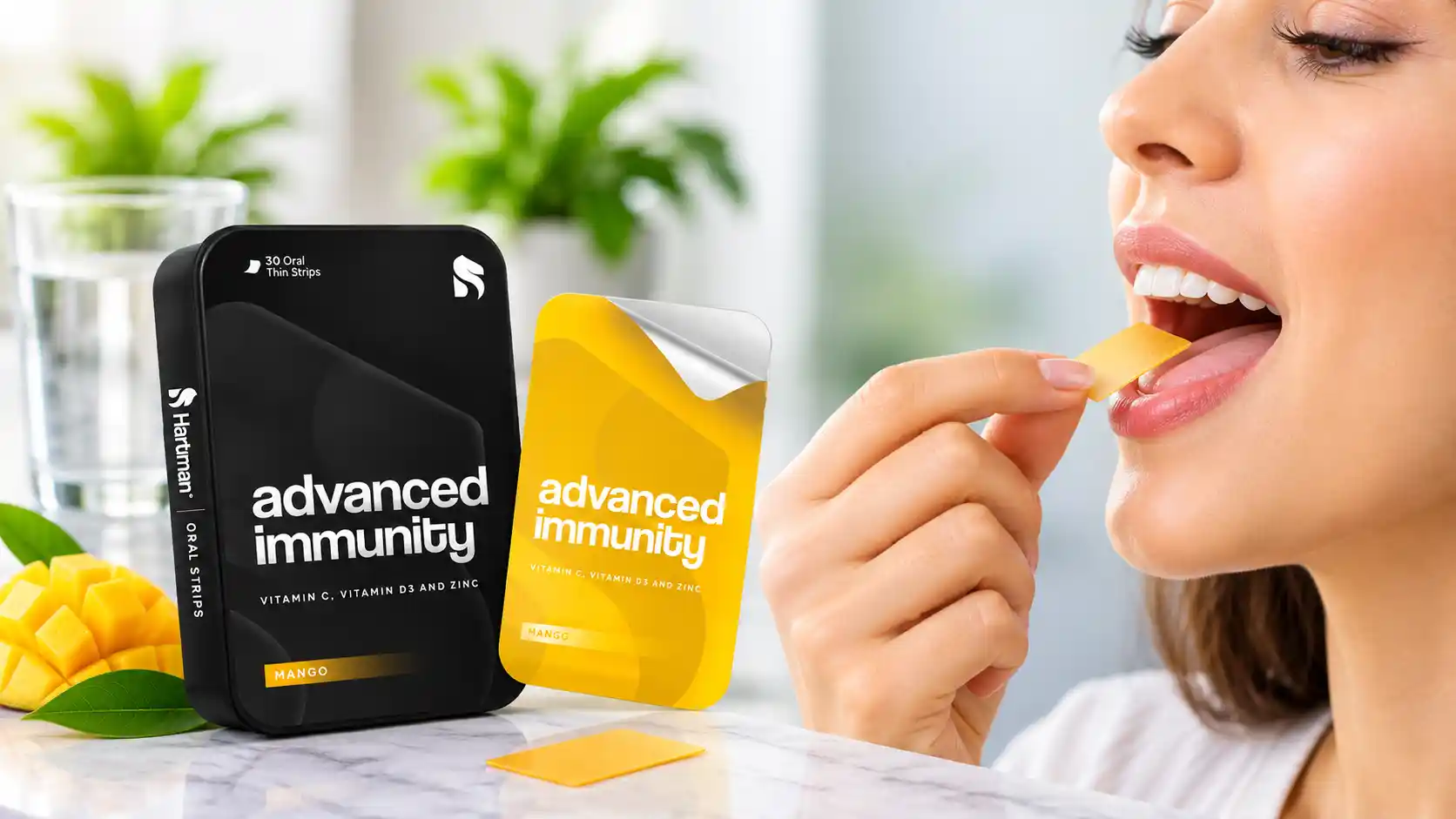
Oral dissolvable strips: Also known as oral thin films or oral dissolving films, these are thin and flexible films that disintegrate in the mouth. For the creators of supplements, this is an innovative method of providing select nutrients without the help of any liquid or a spoon, or even without a pill. However, a strip cannot be considered a capsule turned into a film; other factors need to be taken into consideration.
In this article, you will find out how to estimate oral strips, criteria of feasibility, development process, as well as what questions you should ask when choosing a manufacturer for oral strips production. Supplement manufacturers and brands considering custom supplement manufacturing may take into account the following factors.
What Is an Oral Dissolving Strip?
Oral dissolving film is a thin film that is composed of film forming components among others. The film is administered onto the tongue or anywhere in the mouth and gets hydrated by saliva leading to its disintegration. However, depending on the nature of formulation, the contents may be swallowed together with the saliva. The disintegration of the film does not imply absorption or action through the mouth.
Nutritional supplement companies could use strips in their product lines for certain vitamins and caffeinated products and many other suitable ingredients that are allowed in the target market. Suitability of a particular ingredient will depend on the dose of the ingredient, solubility, taste and stability of the ingredient, among others.
Why Might a Brand Choose Strips?
Oral strips have some possible advantages based on the concept of the product and target consumer.
- Portability: The portability factor of a compact unit will make for a great travel companion.
- Water-free consumption: This can appeal to consumers who find preparation of drinks a burden.
- Uniqueness: Strips give uniqueness to a product range in terms of being different from the capsule or powder form.
- Specific unit concept: The strips can be produced for specific units of nominal ingredient quantity, which has been validated.
However, there is an aspect of limited space available. An attractive slim strip can’t necessarily be utilized in all formulas having high dosages. The best thing is to choose the form factor which would be suitable for your product idea and not the most innovative. In the planning of private label supplement manufacturing for your own brand, the serving size should be kept in mind.
Which Ingredients Are Suitable?
Feasibility is an issue related to formulation, rather than an absolute list of yes/no answers. Smaller dosage ingredients tend to be more feasible than large ingredients that require dosing in grams. Water-soluble ingredients are different from difficult-to-dissolve powders. Botanical extracts are known to have very distinct flavors and colors. Some ingredients can react with film formulation and drying.
The feasibility assessment will include:
- Actual grade of the ingredient
- Amount per strip
- Number of strips per dose
- Film size
- Expected flavor
- Country where the strips will be sold
Legality and classification of the product ingredients should be considered separately from feasibility. These factors are important during oral film formulation and oral thin film formulation development.
How Much Active Ingredient Can a Strip Hold?
No universal maximum dose is supportable for any oral film. The loading capacity will depend on the active, the excipients used, the area of the film, the film thickness, the flexibility of the film, and the allowed disintegration rate. Inserting more active into the film could result in a thicker, less flexible, harder-to-disintegrate, or simply more bitter film.
For a startup, the question is, "Can I make this formulation at the size and sensory quality I want?" Not "What is the largest dose you have ever made in a strip?"
If the dose suggested is invalid, other options are as follows: -
- Multiple strips for each dose
- Modifying the product formula
- With an alternate delivery mechanism
One of the adjustments must be assessed in relation to patient adherence.
Why Taste Masking Is Central to Development
The strip is placed inside the mouth, and therefore any bitterness, tartness, aftertaste and mouthfeel will come to attention immediately. Caffeine and some plant extracts are especially hard on the mouth. The developer can try a different set of flavors, sweeteners, tartness, quality of ingredients or any other appropriate processing method. But taste masking should not affect film integrity, stability and ingredient release.
A prototype testing could consider not only if the first second tastes good, but also how the film dissolves and feels after it disappears. Problems of lingering bitter taste and unexpected powdery feel can show up early enough before the manufacturing.
How Oral Strips Are Typically Developed and Manufactured
Concept and Market Brief
This description outlines the brand, target consumer, proposed activities, serving idea, market, desired flavour and pack size. It is also useful for contract supplement manufacturing.
Technical Feasibility
How do you explain the excitement of sitting in a 'freezing train' all to get out at the same time?
Prototype Formulation
Film-forming base and suitable excipients are chosen. Prototype films are formulated and assessed for appearance, flexibility, taste and disintegration.
Iteration and Specification
Refine the formula by feedback. The version that is approved should be specified and agreed upon for the criteria and testing parameters as well as packaging parameters.
Commercial Production
A typical solvent-casting approach prepares a mixture, forms a controlled wet layer, dries it, cuts the film and packages units. Other manufacturing technologies exist; the actual process depends on the facility and formulation.
Quality Review and Release
The finished product is assessed against agreed requirements, which may include:
- Appearance
- Mass or thickness consistency
- Active content
- Disintegration
- Microbiological quality
- Packaging integrity, as appropriate
Why Scaling Up Is Not Just Making a Larger Batch
An encouraging prototype at bench level must succeed using commercial machines. Mixing properties, bubble size, viscosity, evenness of the coating, drying and cutting conditions will vary depending on scale. The same combination of ingredients may act differently under different conditions.
A realistic product launch schedule allows for this.
Packaging: A Technical Requirement, Not Just Branding
The oral film packaging film is essential when developing the product as there could be a sensitivity to moisture and handling of the unit. The use of individual barrier sachet packs has been suggested due to the protective nature of the sachet before use. An attractive tin or carton could be used as well, but an outer package is not a substitute for the protection provided by the primary packaging.
Packaging decisions need to be guided by:
- Stability needs
- Shelf-life goals
- Transport conditions
- Consumer convenience
It needs to be determined from the beginning what packaging the founders desire; individual sachets, sachets inside a carton, or other suitable packaging options.
What Quality Tests Should Founders Discuss?
The quality review should be based on the product, formulation, manufacturing process and destination market. Founders can discuss the following with their manufacturing partner:
- Identity and content of relevant active ingredients, with a justified test method.
- Uniformity of the film or delivered unit, as appropriate to the product.
- Appearance, physical integrity and disintegration behaviour.
- Microbiological and other safety tests appropriate to the product category..
- Packaging integrity and stability in the proposed market and distribution conditions.
- Documentation available from the selected manufacturing facility and testing partners.
All tests are not necessary for all food supplements, and the regulations vary depending on location. It is best to consult the company as to what tests are regularly performed, project-specific tests and independent tests.
Oral Strips vs Gummies, Capsules and Powders
Each form of the supplement comes with its pros and cons. Below is an overview of oral strips, gummies, capsules, and powder forms for your guidance.
| Format | Potential Strength | Main Constraint | Often Worth Exploring When... |
|---|---|---|---|
| Oral strips | Portable; no water | Limited practical ingredient load; taste and moisture | Convenience and a small serving are priorities |
| Gummies | Familiar, enjoyable format | Taste, texture, sugar systems and load | A chewable experience matters |
| Capsules | Taste is largely concealed | Fill volume and swallowing preference | Ingredient compatibility and simple dosing matter |
| Powders | Can support larger serving sizes | Preparation, taste and pack size | Higher ingredient quantities are required |
These are general trends, not claims to being more effective. The best form to use will vary according to the specific components used.
What Drives Oral Strip Development and Manufacturing Cost?
Cost is shaped by several factors:
- Ingredient grade and quantity
- Development work
- Taste-masking complexity
- Film dimensions
- Production process
- Testing
- Packaging materials and print requirements
- Logistics
Brands should request quotations against a clearly defined specification rather than comparing prices for loosely described products. Hartman discusses production requirements and commercial feasibility privately for each project. These details can also help brands evaluate custom supplement strips as part of their product development plans.
What About the US, UK, EU and Australia?
A strip’s physical form does not determine its legal classification. Different regulations for a particular product might depend upon ingredients, claims, the intended use, and jurisdiction.
In the US, dietary supplement regulations and labeling laws may apply to the product where they qualify as such; in the EU and UK, there could be consideration for food supplement and novel foods; while in Australia, food and medicine distinctions will need more attention. The regulatory assessment process should take place prior to developing formulas and making claims.
It should never be assumed that a film made in one country can be sold without modification elsewhere. This should be confirmed by the brand and their regulatory experts.
What Should You Send a Manufacturing Partner?
A concept brief that makes clear what you require from the manufacturer would make them understand your requirement and get into a feasibility discussion. The brief must include:
- Your target market and positioning of your product.
- Names of ingredients, grades required along with quantities per serve.
- Number of strips per serve and size preference, if any.
- Preference for flavor and sweetener and exclusions, if any.
- Packaging idea and retail presentation desired.
- Timing of launch and any reference product available.
There is no need for you to have answered all technical queries before sending the query.
How Hartman Supports Oral Strip Projects
Hartman collaborates with brands to create private label and customised oral disintegrating strip products. This involves working with our manufacturing partners to facilitate feasibility talks, formulation creation, prototypes, and manufacturing. The goal for us is to guide founders through what is required and get the concept into a product spec.
We are aware that all combinations of ingredients that one wants to use cannot fit into a strip. We discuss these limitations with the client when they occur. Private label oral strips brands can start a feasibility talk by submitting the ingredients, market, and packaging they want.
Conclusion
Oral dissolving strips have the potential to provide a unique supplement experience—provided that the entire system of the film is developed in unison. The active ingredients, the film base, the flavouring, the manufacturing process and the packaging will all need to be integrated as part of a single package for the development to succeed.
Develop an Oral Dissolving Strip with Hartman
Looking for an oral dissolving strip concept? Hartman offers customised, targeted product solutions, including specialised formulation, flavour, and packaging, just to name a few. Share your product demands with us to see what development options are available.


